
Everybody's Got a Water Buffalo
Part 3: Memoir illustrating my first experiences in ABA-for-Autism, in response to big-media misrepresentations

“The Water Buffalo” song from Veggie Tales is the theme of today’s memoir essay. As a founding member of Stories from the Jukebox, it was my turn to choose this week’s song, and it happened to coincide with a series on Applied Behavior Analysis for autism, or ABA-for-autism (here are Parts 1 and 2).
This essay is intended to illustrate one way in which ABA-for-autism is implemented, in early intervention. More explanation at the end. It might help to listen to the song first, but I appreciate you reading in any case. Original narration included but be forewarned: I sing. Poorly. ;)
100% human writing
Setting: Early 2000s. A small school for children with autism. Learners, ages 2 - 15, get one-on-one instruction for 3 - 6 hours a day (with breaks, of course) from bachelor’s and master’s level clinicians, or instructors. Parents pay out-of-pocket and instructors make barely above minimum wage, but it’s entirely worth it for both parties. Let’s see why. (Names and details modified for privacy.)
“Ooooooooooooooooooooooooooooooooooo!”
I held the note for 10 long beats while dancing a jig and deftly avoiding a self-inflicted concussion on the cabinet above my head. It was stuffed with diapers and spare clothes of all sizes, toilet schedules, and Ziplock bags full of M&Ms and Mike & Ike’s that my coworker painstakingly cut in half, one by one, with a pill slicer earlier that week.
“Everybody’s got a water buffalo. Yours is fast, but mine is slow,” I repeated the first verse, in an affected Southern twang.
As a 21-year-old former lifeguard, what I lacked in pitch perfection, I made up for in lung capacity and volume. This job let me show off some of my silliest skills.
“Took my buffalo to the store, got his head stuck in the door —”
The young child sitting butt naked on the tiny toilet at my feet giggled as I pantomimed getting my head stuck in the door of the cabinet, while I ensured its contents didn’t avalanche out on us.
My supervisors—master’s level clinicians, or “BCBAs”, an acronym that was lost on me at the time—had previously told me they appreciated the enthusiasm I brought to all of my sessions. That’s what we called them, sessions. One of the many words in a whole new language it’d take me years to truly master — and sessions wasn’t even a technical term.
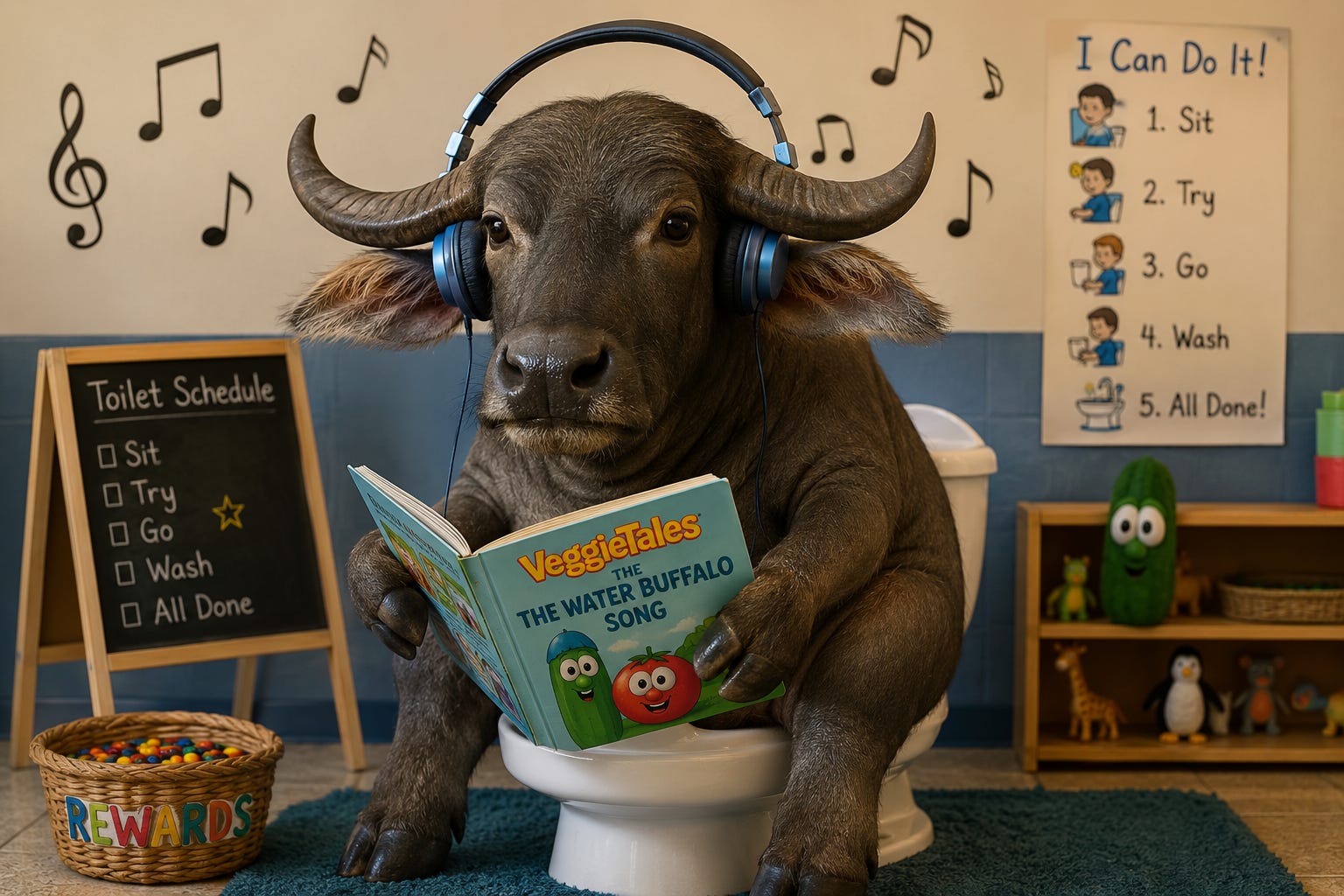
It was good my superiors appreciated my energy because their office was on the other side of the wall, so they got to hear this tune (and more) every 30 to 45 minutes, in 3-hour shifts, from Monday to Friday. To save you the mental math, that’s 4 to 6 performances a day.
And it wasn’t only this song. This kid’s love of Veggie Tales ran deep. With silly on my side, I performed “The Bunny,” “The Song of Cebu,” “His Cheeseburger,” “Love My Lips,” and “The Pirates Who Don’t Do Anything” better than any zucchini around.
And that’s not all my supervisors heard from us.
They heard:1
”EEEEEEEEE,” the only sound Ned, the toileting 4-year-old at my feet, made a few months prior, before I (under their supervision) taught him to use sign language for his most-frequent requests. I also taught him some words that were just plain fun, because why would anyone interact if it wasn’t occasionally fun?
They heard:2
“Ready, set, ______!” (a pause for him to fill in “go” in sign language), followed by,
“Goooooooooooooooo!” with accompanying running feet, rattling wheels of a Fisher Price push-and-ride toy, the vocal miming of breaks, and more laughing.
They heard:3, 4
“Okay, time to show me what you know! [as I put out array of items and pictures]
Which one do you ride? [he pointed to a bike] Great job!
Show me the picture of your mom. [tiny point] Way to go!
What’s your name? [signed, Ned] It sure is, don’t wear it out!
How old are you? [five little fingers] Oh, so close! You’re four. [prompted the correct response, he imitated] That’s it, big guy. How old? [correct sign] Great job!
Can you do this? [modeled a fine motor movement; he imitated, or tried] Awesome, opossum!
What about this one, can you do this? [I modeled rubbing my belly and patting my head; again, he tried.] That’s great trying, I love it!
Let’s trace this letter, “N” [Ned picked up the pencil, clumsily. I assisted, narrated, and praised his attempt to trace]
Last one, what’s your sister’s name? [He made a vocal approximation with sign for Jane]. Yes! You got it!
Guess what? Play time! What do you want, video or animals? [He signed “animals.” I removed the teaching materials, offered a basket of animals, and we went to play.]”
They heard:
Me, making the sounds of all the animals, including the ones I made up — a penguin, giraffe, and gnu.
They heard:5
“What do you want, earthquake?” As I prompted vocal imitation (echoics) of the “aaaaa” in “earthquaaaaaaaake” — and then, when he tried to imitate, they heard me again say, “earthquaaaaake” as I shook the platform swing until he fell off, onto the soft mats in the OT room. (Don’t worry, this was safe and one of his favorite activities!)
They heard:
Me narrating our play, prompting him to share with peers, and the copious praise when he did something new or independently for the first time.
They heard:6
“Not to fret, we have all kinds of rainy day choices!” when he sat at the door and cried and hit his head because he wasn’t allowed to outside in the rain. (I wouldn’t have been opposed, but it wasn’t allowed. Comforting him in this situation, when he wanted something he couldn’t have, was two decades ahead of the research.)
They heard:7
“We’re rolling up to a birthday party. We’ll only get as close as you want today,” as the wheels of an office chair inched closer and closer to the room with the loud gathering.
Over the wheels, they heard Ned begin to whimper and me say, “Okay, close enough. Let’s mark the floor. That’s as far as we got today,” as I marked the baseboard with colored chalk and wheeled him away.
Ned was scared of birthday parties — particularly the singing and clapping — which caused an intense fear reaction, affecting his and his family’s quality of life. So, we intervened by offering him headphones (to quiet the noise) and competing stimuli (he sat in a rolling office chair, holding his favorite animals); and we used stimulus fading (graduated exposure). By my recollection, it took maybe 10 trials spaced across months, but, eventually, Ned was able to attend and participate — and ham it up — in social gatherings with clapping and singing.
After about a year, they heard:8
Ned’s sweet little voice stringing together longer and longer sounds, until he was approximating full words. Not only the words of things he wanted, but, because I was taught to follow the child’s motivation, and because Ned was highly motivated by animals, he also learned facts. Adorable facts, like…
“What do cows eat?”
“Ass,” he said, as he signed “grass.”
Back in the bathroom, I continued the Water Buffalo performance. Ned smiled and rocked, anticipating the character acting.
“No, no, no, stop right there!” I imitated Archibald in my best English accent. “Not everyone has a water buffalo! We’re going to get angry letters saying, where’s my water buffalo, and why can’t I have a water buffalo?”
Ned peed. Mostly in the toilet. A win.
Like the best mixed tapes, I didn’t skip a beat and led directly into the song and dance routine we’d made up together:
“Way to go! Pee-pee in the pot-TY! Pee-pee in the pot-TY!” The chant was accompanied by a cabbage-patch hand movement and a little maraca-shake on the “-ty!”
I helped Ned down from the toilet, assisted him into his pull-up and clothes, and we both danced to the sink to wash our hands. (He preferred toileting naked, so we allowed it. One day, he just…stopped getting fully naked. We allowed it. Either way, as long as he was happy and everyone was safe, it was all good.)
With his parents’ participation at home, it didn’t take long to fully toilet train Ned. (Method 9 and research in footnotes10 )
It only took a few months to teach Ned over 100 signs, most of them animals. After that, it was only a matter of time practice and science-informed teaching that we had him speaking in approximations, then full words. (No, he didn’t get Speech Therapy at the time; he was on a waiting list.)
Within a year, he dropped the sign language on his own, as most people understood him. And then, a year later, when he was “caught up” to the skills required by public school in America — reading, writing, group participation and learning — I helped transition him to a general education setting. (By “helped,” I mean I quit my job at the school, started my own private-pay business, took on other clients, and went to school with him until I worked myself out of a job.)
At first, Ned’s teachers needed support with some of his more challenging behavior— actually, they needed to be taught to change their expectations and make accommodations that would help him succeed. They also needed to be taught why he was doing what he was doing, so they could support him and their other students.
Mostly, Ned wanted more independence to do what he wanted to do. When it was given to him, he was happy, but when he felt un-free, he was not. Sounds like most of us, right? Ned and his teachers needed to accommodate each other’s needs. I helped, using behavior science.
Ned now has a college degree in computer programming.
He still likes the Water Buffalo song, but he toilets just fine without it.
Author’s Notes
As mentioned, this was Part 3 of a series devoted to Applied Behavior Analysis for autism, or ABA-for-autism, prompted by some recent “bad press” my field has gotten and the heat we’ve been taking for a while.
Part 1 included historical and current context. Part 2 was an explanation of the enormity of the topic and how difficult it is to show the general public what ABA-for-autism entails. This, Part 3, was an attempt to show a variation of ABA-for autism, early intervention. It illustrates how broadly we teach: Language and skill acquisition, life skills, reducing challenging behavior and teaching self-regulation, etc.
I was hugely lucky that my first experiences with ABA-for-autism were so impactful, and that I was introduced through play-based teaching.
The school was founded by a parent of an autistic child and an SLP who’d studied under Vincent Carbone, a big proponent of play-based learning to teach verbal behavior. I was rapidly educated in this “verbal behavior approach,” and assessment tools such as the ABLLS and, in coming years, the VB-MAPP. (Comment if you want to know what the acronyms mean.)
This was also the early 2000s, before insurance began paying for ABA-for-autism, dictating what can and cannot be done, how much supervision and parent training happens, etc.— and it was long before Private Equity investors saw dollar signs in our practice.
In coming decades, the involvement of non-experts with financial motives rapidly changed the landscape of services, education, and research in my field. But, in my experience, at good ABA-for-autism clinics, early intervention includes variations of what I described. Play mixed with “table work,” alongside teaching developmentally appropriate life and social skills, all using procedures rooted in the concept of operant conditioning and over 100 years of an ever-evolving science.
Regarding that science and research, one thing I’ve noticed in my many years is that clinical practice often outpaces research. For instance, the use of “kind” extinction (aka comforting a crying child) and graduated exposure for birthday party phobia — methods illustrated above—would’ve been great research papers in the early 2000s, as would any number of things my teams have done in practice over the years. There simply isn’t enough time to jump all the hoops required to get a new or creative application into a research journal. So, what is done in practice doesn’t always make it to research, even though the assumption is that the gap only goes the other way.
Another thing relevant to my early experience is that, prior to working at this school, in undergrad, I had experience with TEACCH, a cognitive psychology approach to teaching autistic people, as well as a Direct Service Provider (DSP) for teens and adults, offering community support and respite care. In those positions, I’d worked with several children, teens, and adults with autism and other disabilities, and I hadn’t seen anything so effective as ABA.
The sheer efficacy and monumental changes — the “magic” of ABA-for-autism, compared to other approaches — is why I spent the next two decades learning all I could about the science and philosophy behind the procedures. ABA isn’t just for autism — Behavior Analysis is an entire discipline of psychology, with many types of research and applications. The philosophy is beautiful and thoroughgoing. It’s helped me make monumental changes in my own life, for some very big struggles.
This water buffalo was finally led to water.
Next up in this series, now that you understand some of what ABA-for-autism entails, we will dive deeper into the bad press we’ve recently gotten as a field. Some of what was reported is true, but, mostly, it’s misleading and harmful to the many people who benefit from ABA every day.
Thank you for reading. Footnotes below.
Peace, love, and stimulus control,
Jennifer
P.S. Calling all Poets, Fiction, & Non-Fiction writers that love music — Share your prose of 1500 words or less, using the prompt, The Water Buffalo Song. It’s a great way to connect with new readers. Find instructions here.
Tincani, M., Bondy, A., & Crozier, S. (2011). Teaching verbal behavior. Handbook of Applied Behavior Analysis, 270-280.
Goldsmith, T. R., LeBlanc, L. A., & Sautter, R. A. (2007). Teaching intraverbal behavior to children with autism. Research in Autism Spectrum Disorders, 1(1), 1-13. https://doi.org/10.1016/j.rasd.2006.07.001
Frank‐Crawford, M. A., Borrero, J. C., Fisher, A., Talhelm, P., & Fernandez, N. (2024). Discrete‐trial teaching: A scoping review. Behavioral Interventions, 39(3), e2012. https://doi.org/10.1002/bin.2012
This section illustrates a variation of discrete trial training in which the target tasks are mixed and varied across modalities, and mastered and not-yet-mastered skills are interspersed. It also illustrates praise on an “FR1 reinforcement schedule” and the importance of varying one’s praise. Finally, it illustrates teaching age-appropriate skills and allowing for approximations, or imperfect responses, to be correct.
Yoder, P. J., & Layton, T. L. (1988). Speech following sign language training in autistic children with minimal verbal language. Journal of Autism and Developmental Disorders, 18(2), 217-229. https://doi.org/10.1007/BF02211948
Tarbox, C., Tarbox, J., Bermudez, T. L., Silverman, E., & Servellon, L. (2023). Kind extinction: A procedural variation on traditional extinction. Behavior Analysis in Practice, 1-11. https://doi.org/10.1007/s40617-023-00833-w
So many clinical interventions have gone unpublished. We were really head of the curve back then. Graduated exposure for birthday party phobia…
Schmidt, J. D., Luiselli, J. K., Rue, H., & Whalley, K. (2013). Graduated exposure and positive reinforcement to overcome setting and activity avoidance in an adolescent with autism. Behavior modification, 37(1), 128-142.
Abdel‐Jalil, A., Baldwin, J. N., & Leaf, J. B. (2024). Exposure‐based treatments for fear and reactivity to medical procedures: A systematic review of the literature with implications for research and practice. Behavioral Interventions, 39(3), e2010.
Barbera, M. L. (2007). The verbal behavior approach: How to teach children with autism and related disorders. Jessica Kingsley Publishers.
The potty schedule, noncontingent reinforcement, and differential reinforcement (of elimination) were hugely effective. We started slow, by making the bathroom a fun, non-scary place. Then we started changing diapers in there, while singing. Then we went regularly, even if he’d soiled his diaper, continuing to make it fun. We made it extra fun when he eliminated on the toilet. BM took a little longer to teach, simply because there were fewer trials and he had to learn a new bodily signal, but the concepts were the same. Eventually, he was going independently, without all the entertainment. Life outside the bathroom was better.
Bacotti, J. K., Perez, B. C., & Vollmer, T. R. (2023). Reflections and critical directions for toilet training in applied behavior analysis. Perspectives on Behavior Science, 46(3), 447-458. https://doi.org/10.1007/s40614-023-00384-z