
Maybe Writing Was Never "The" Thing
On misinformation, making sense of my writing journey, and accidentally imagining my dream job
I recently returned from nearly two weeks in France.
It was relaxing, restorative, and helpful for self-seeing. My to-do, to-solve, and to-write lists didn’t come with me. And something interesting happens when you step away from your daily stimuli with behaviorist eyes: You start to see who you are without them. When life’s demands are removed, certain patterns just... fall away. If you’re looking, you get to see that you — an ever-evolving composition of do-say-think-feels — are a product of your conditions. And “conditions” are no small variable!
The Jennifer who remained, once my life was reduced to carefree traveler, was someone I recognized and loved being — jovial, unbothered, making copious notes on creative writing ideas just because I felt like it. And when I landed back in my regular life, under my regular conditions, I could see myself more clearly than ever.

While away, unable to not write, I shared several Notes inspired by my travels — on beinveillance; the contentment, relaxation, and hope I felt while away; the poem-inspiring art (my fav) and scenery; the way verbal behavior separates us; the darling people I met, including the multi-talented Jocelyn Ulevicus , and how grateful I am for you, Substack readers. When I returned, I wrote about meeting Jocelyn in person, and posted in Operant Spirituality about an everyday miracle and trusting intuition — topics most behaviorists won’t touch with a ten-foot pole.
I came home and did what I always do after a trip — caught up on work, posted photos, settled back into my routines. One of those routines involves getting deeply interested in whatever issue is currently capturing my attention—a pattern I've spent a lot of time trying to understand and be more intentional about.
Perfect timing, right? Here I was, a newly refreshed self, fresh out of an airtight French container, presented with an opportunity to not engage in stale, old-self patterns. And, wow, did an attention-captivating topic come along!
See, there’s been a recent wave of “bad press” about my field. The New York Times and Wall Street Journal have run several pieces on Applied Behavior Analysis (ABA) for autism, framed around Medicaid fraud and abuse. (I’ll link them and discuss in my next post.) The facts in them aren’t all wrong, and instances of fraud and abuse do need addressing, wherever they occur. But the journalists omitted a lot of important context, misrepresented the evidence base for ABA-for-autism, and badly distorted a science that is much bigger than, and separate from, the parts of the autism industrial complex these articles are actually criticizing.
Before I left for France, I’d seen the headlines and made a choice not to let them follow me. That’s a skill I’ve worked hard to hone, the ability to set something down and be genuinely, if temporarily, unbothered by it. I don’t always manage it, but I did…
Once I was home, though, fresh-Jennifer hit old air. Stale-Jennifer took over. I dove in. I reread the articles. I videoed myself reading one aloud with commentary (still unreleased). I drafted responses, made an Instagram reel, wrote Facebook posts, even wrote a short fiction piece. I reminded myself (and my FB readers) why I’m qualified to speak on this. I brainstormed resources for other behavior analysts. I talked to colleagues, asked for peer review, and got it.
In short: I generated a mountain of words, across every platform, every audience.
There I was, failing this test from the universe — or so I thought. (I’ll get there.)
So, with all these words, even though I’m genuinely reluctant to use AI for writing (I care about the craft and the environment), I hit a point where I just needed help organizing and finding the next step. Plus, I was berating myself for “failing” and jumping on another hot topic — was I doing it with intention? So, I dumped everything into ChatGPT: old posts, drafts, notes, reel scripts, comments, half-formed ideas. I asked, can you help me make sense of this?
It told me I didn’t have one article, I had five or six different projects, tangled into one pile:
a piece on my own credibility to speak on this (”who am I to speak up?”)
a direct response to the NYT/WSJ coverage
a piece on misinformation and media framing more broadly
calls to action for behavior analysts, for people who’ve benefited from ABA, and for the general public
a fiction piece imagining the article that should have been written
a reckoning with what my writing life actually entails, behaviorally and motivationally — and how much of it isn’t “writing” at all
That last one, # 6, is what I wanted to tell you more about today. The others I’ll condense and share later.
For months, I’ve been circling similar questions, trying to figure out which problem to solve first. Writing feels too big to hold. I have too many social media accounts, including three Substack publications. I have too many competing projects and can’t catch up on them and continue to post new writing and tackle hot topics. I can’t seem to “niche down.” I keep splitting my attention across audiences and formats despite “knowing better.” Why can’t I just pick one book project and see it through?
I’d been treating all of this as problematic — too many projects, too many platforms, too many audiences — and looking for behavioral solutions. Stimulus control, reinforcement, response effort, motivating operations… but I hadn’t considered the motivating operation underlying all of it.
The reason I started a public presence all those years ago was to address misinformation and present behavior analysis and behaviorism in creative and accessible ways. Along the way, other motivations—writing for myself, exploring memoir, wondering whether writing could become a career—got layered on top.
So, for years, I’ve been writing memoir, fiction, poetry, essays, Notes, Facebook posts, Instagram captions, videos — across several platforms, building different audiences, the way all writers eventually do if they want to sell books. I thought writing was THE thing I was working toward—a backup career to which I could escape.
But, the longer I’ve been on Substack, the more I’ve learned, the more I see: writing, as a career, isn’t any more aligned with my values and needs than my other career options. It’s also, frankly, an unreliable way to make a living, which I don’t have the privilege of not worrying about at this stage of my life.
And I think my issues with not completing a book project are about avoiding the moment it becomes something I have to sell—the moment a finished product becomes an extension of my identity and something else to manage. I also don’t want to give any responding up. I like writing, I like novelty. Editing and marketing aren’t writing, and some part of me enjoys finding new things to write instead of finishing what I’ve already started.
So, I was hitting a wall, saying I was burning out with all of it.
But when this ABA controversy landed, I felt energized again. Genuinely energized, not distracted. Intentional. Not writing-for-relief.
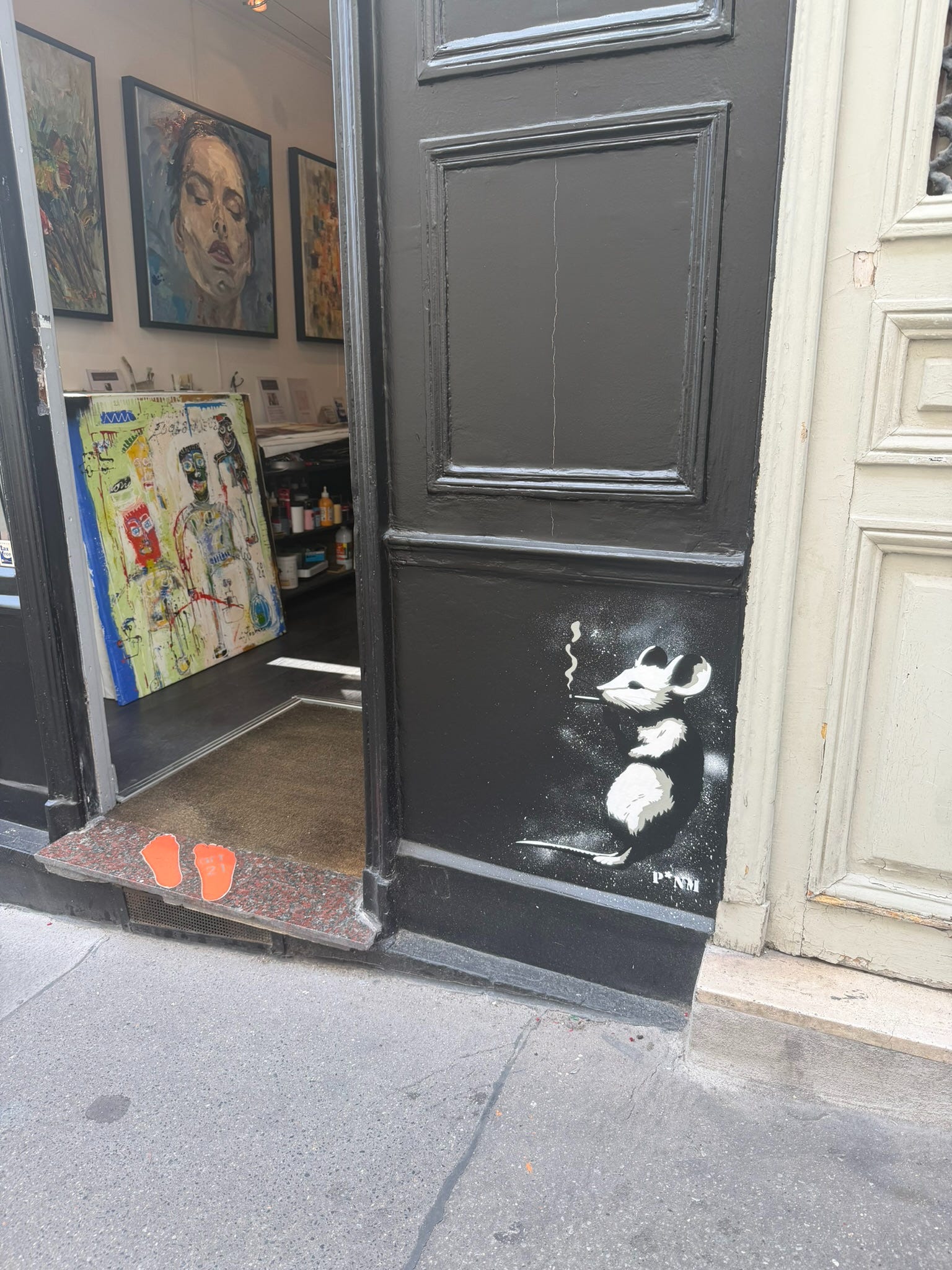
An Aha! Moment
Looking at stale-self behavior with fresh-Jennifer eyes — and recalling the selves I’ve seen when reviewing and organizing my existing projects for the past 6 months — I noticed something I hadn’t seen before: whenever a chance to correct the narrative or teach from example shows up, I get energized. Focused. I start researching, drafting, building resources, talking to people — trying to understand what actually happened and how to explain it clearly to others.
That’s when it clicked. Maybe writing isn’t THE thing. Maybe writing is one of several ways I do the thing.
The thing is public sense-making. Translating complex ideas for ordinary people. Correcting distorted narratives. Taking a story that’s been flattened and helping people see the fuller picture underneath it, and what they can do to change it.
When I look back, that thread runs through almost everything I’ve done online for the last five years: My memoir, fiction, field-related essays. My videos and dissemination. My attempts to explain private events, grief, relationships, spirituality, and everyday life through a behavioral lens. Even political diversions on my personal Facebook account (which stopped months ago).
I keep asking the same question, in every format: is that actually what’s happening here? Let’s look at it more carefully. Let’s look at the behavior. Let’s look at the contingencies and outcomes. Let’s look at the facts.
And I ask that of myself, too. I imperfectly model a behavioral approach to self-awareness — a willingness to self-inspect publicly— which I think is part of what makes my writing appeal. I’m willing to look at my own patterns in public, admit when I’m not at my best, and change. That’s not a small thing, and it’s rarer than it should be.
My Dream Job
As I was writing about the recent media coverage, I found myself imagining resources that don’t currently exist: comparison charts, with peer-reviewed references, showing what is and isn’t true of ABA-for-autism and how those same criticisms apply across many “autism therapies.” Resources for legislators, journalists, and families trying to make sense of competing claims. Rapid responses to misinformation as it spreads through social and mass media. Interviews with experts. Historical context. Fact-checking. Public-facing explanations of complicated ideas, written so a non-specialist can actually use them. Conference presentations. Films. Outreach.
The more I wrote, the more I realized I wasn’t simply responding to bad press. I was describing a job.
A job devoted to tackling misinformation and disinformation about behavior analysis and behaviorism. A job perfect for my unique history and combination of skills. A job that doesn’t exist. At least not yet.
When I described it in a series of posts for my Facebook audience, I didn’t say “someone should do this,” but “I should do this.” That was huge because I rarely step into my power that way. The truth is, I’ve spent 20+ years in my field, across clinical, academic, research, and practicum settings; I have the research and broad skillsets such a job would need; I’ve spent the last 5+ years establishing a track record of translating dense information for laypeople, responding to media misrepresentation in real time; and, most importantly, I’ve demonstrated a willingness to do this work whether or not anyone’s paying me to do it! I’ve been doing a low-budget version for years. I’d like to do it formally, with the resources and backing it deserves, to make it more sustainable and separate from my writing efforts.
So here’s where I’ve landed, at least for now: my dream job might not be “writer” — or not only writer. It might be tackling misinformation about behavior analysis and behaviorism, full-time. Not as something I squeeze in around clinical work and everything else. As an actual job, with pay, ideally with a team to lead.
Because misinformation about my field doesn’t just affect autistic people and their families, or the practitioners who work with them. ABA is a much bigger umbrella than autism — it’s being used in education, healthcare, gerontology, environmental and organizational behavior, even detection-animal training. When the public’s understanding of “ABA” gets reduced to one set of controversies, the cost is distributed everywhere that science gets applied, for everyone whose problems it’s helped solve, and those who’ve yet to experience it.
My dream job doesn’t yet exist. But I wrote a description and said it out loud: I’m already doing this. Let me do it better, universe.
What’s Next
In the absence of this dream job, I still have my current work — which, to be clear, isn’t unsatisfying, it just doesn’t allow me to use my full wheelhouse of skills or affect cultural change. So, my “writing time” responding will still be affected by many competing motivations and sources of stimulus control. But now that I see how my 'address misinformation' motivation underlies so much of my writing, I can be more intentional when hot topics arise.
I have several pieces coming out of this— a response to the NYT/WSJ coverage that I’ll post here, a letter I’ll send to the editors, some resources for other behavior analysts, and yes, that fiction piece, too. But I wanted to start here, with the motivation underneath all of it. I don’t have a new writing plan, per se, but I do have a clearer sense of what I’ve actually been doing and want to keep doing. If I could separate the motivation to address misinformation, or give it more space than my two to three hours of daily writing time, I could do so much for our field, and for myself.
That’s why I’m also going to approach my field’s major organizations and try to make such a position happen. Having such a job that better aligns all of my skills and passions would allow me to approach “writing” a lot differently. I’d love to be able to separate it from my misinformation mission, and to continue that mission more formally, with resources enough to give it my all.
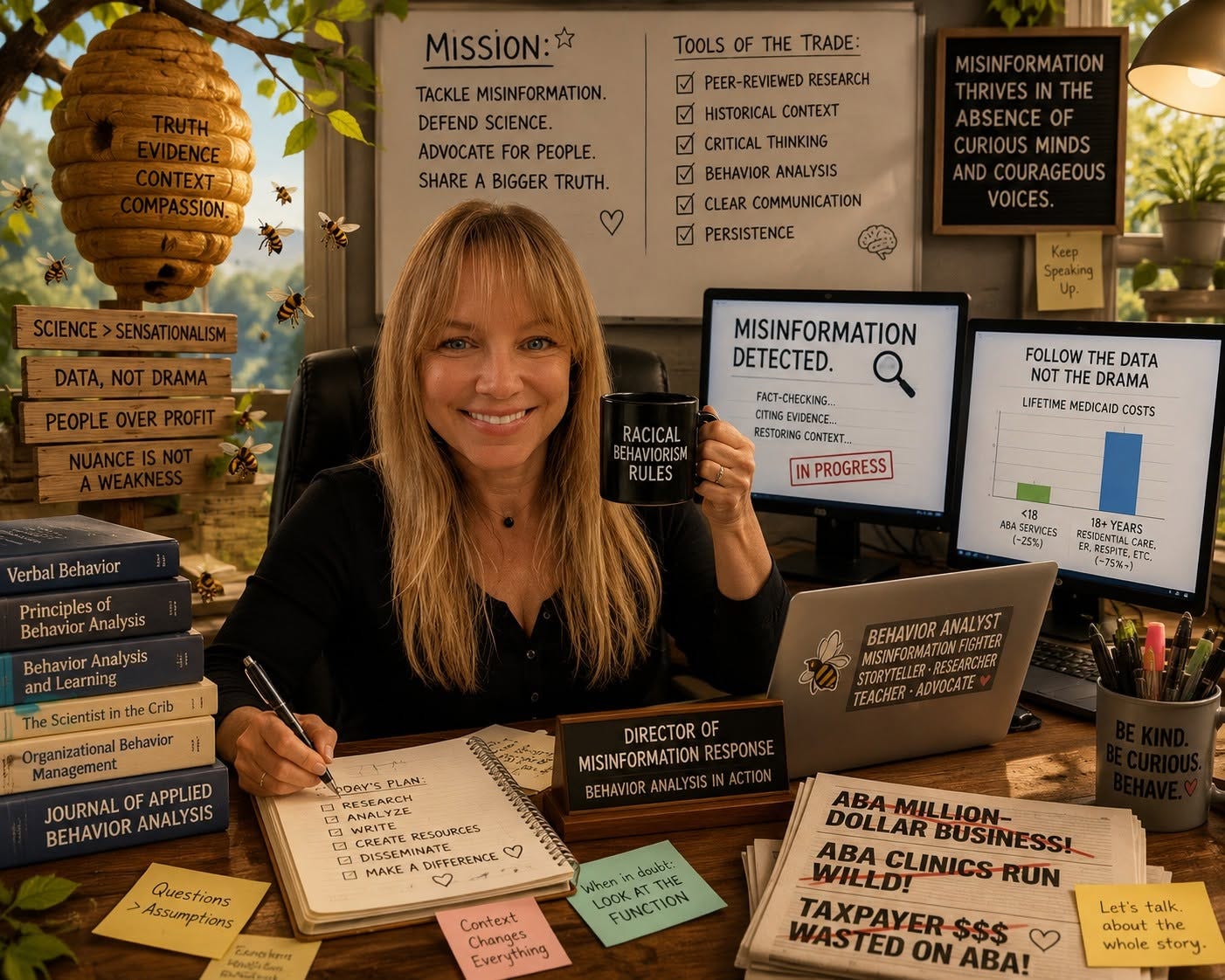
I’ll leave you with this: at some point during all of this, I asked ChatGPT to generate an image of me as “Director of Misinformation Response” for one of my field’s professional organizations. The image is ridiculous (it can’t get my limb difference right, and it gave me a wedding ring — what in the ever-loving patriarchy?), but, if I had a vision board, it’d go on it.
Thanks for reading. If this resonates, share it with someone who needs to hear it — or with someone who has pull with my field's major organizations. I’m only half joking. The sooner this job exists, the sooner I can put my full skills to work and get back to writing for the sheer love of it.
Peace, love, and stimulus control,
Jennifer
It certainly ain’t my thing, Haddock, I stink at it! Hope you’re having a fun weekend
The Jennifer who remained
The one who remains is me I guess. Cool cool