

This week, I’m headlining Stories from the Jukebox, and so is MJ Polk.
It’s not a typical week. This time, it’s a competition between my chosen song and MJ’s. We are kicking things off with our pieces, mine below. You can help me win this dance-off by submitting your own piece, with my song as your theme: Blind Melon, No Rain.
If you want to word-dance, you have 2 weeks to join us on our respective dancefloors by posting your submission and adding your link to this week’s post! The song with the most posts wins all the glory!
My submission is of the memoir genre, written explicity for this post. No behavioral notes today but themes are embedded, of course. If you haven’t watched the music video in a while, it might be a nice amuse-bouche:
Memoir follows. Thanks for reading!

The school bus windows rattled in their frames, loose enough to worry me whenever we crossed a bump or took a sharp turn. I did a lot of that as a child, worry. Always waiting for the other pane to drop on the next sharp turn.
I scooched back from where I imagined the glass would shatter in my lap, all over my first-day-of-5th-grade outfit. The vinyl seats stuck to the backs of my legs in the August heat, gluing me in place. Just as well. My backpack was wedged between my feet, overstuffed with books and notepads — heavy enough to give me scoliosis from carrying it on one shoulder, but not heavy enough to keep it from sliding into the aisle every time we lurched to a stop. I didn’t want to move it. I didn’t even want to be there, on the bus. I’d gotten on a bus all alone once before, long ago, in kindergarden, and it didn’t end well. I hadn’t been on one since.
I wedged my foot between the seat bar and my backpack and pressed play; a soft click and hiss indicated the song was about to begin. My worrries about the window softened. That feeling of being alone while surrounded by people became unnoticeable, as Blind Melon’s optimistic, jangly guitar riff came through my speakers.
Oh, oh, oh, oh
Oh, oh, oh, oh
Images from the music video popped into my head. The young girl, a little older than me, dressed as a bumble bee, dancing by her lonesome through the streets, doing her tap dance, searching for her people amongst strangers. A little pudgy, a little awkward, a little strange, but a lot persistent and entirely relatable, to me.
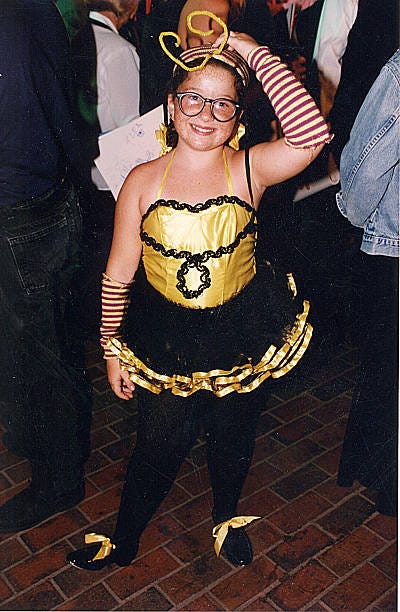
I might not have wandered the streets in a bee constume (yet), but I understood the implications of being outcast by assumptions. So did she. She encountered all walks, and yet no one saw her — not even the otherwise unseen. I was coming up on a decade in this human life, and I already understood this song and video, on an experiential level.
All I can say is that my life is pretty plain
I like watching the puddles gather rain
It wasn’t the official album. I recorded the song off the radio, onto one of my dad’s old cassettes – maybe the Eagles – carefully covering the two corners in scotch tape, so I could trick the well-loved machine. I’d play DJ, hovering above “record” and “play” – hitting them just right to cut Casey Kasem’s voice out at the exact time the music cut in. I played that tape over and over. My friends tired of the song after one play, but I wanted to hear it again. And again. And again.
And all I can do
Is just pour some tea for two
And speak my point of view
But it’s not sane
It’s not sane
The lines about sanity…
I understood not sane. I’d already seen it, in lots of forms. I’d already felt it, been made to feel it. Outcast. Misunderstood. Unseen.
Outside the window, everything moved — trees, houses, cars of the kids whose parents picked them up from school, turning left onto on Country Club Drive as we continued straight, past the marshes, past the graveyard, past the water treatment plant. But listening to this song at max volume through foam headphones, something was almost…still. It was something I could return to, something consistent that didn’t shift depending on who was around, what I did or didn’t do, or what kind of day it was going to be. It was always the same. Same upbeat music, same relatable lyrics. It wasn’t the only song I’d play on repeat, but it remains a lifetime fave.
I just want someone to say to me
Oh, oh, oh, oh
I’ll always be there when you wake, yeah, yeah
My pre-teen heart danced with recognition. Someone famous wanted that? I wanted that, too, someone to be there when you wake, oh ye - ah. More than anything. They were articulating a deep wound, I just didn’t know how to say so. And who needed to say so, when you had upbeat music and a relatable bumble bee?
You know I’d like to keep my cheeks dry today, hey
So stay with me and I’ll have it made (I’ll have it made)
I’d learned a lot about wet cheeks and people not being there when you wake. At one parent’s house, things could change without warning. At the other’s, people could be present but absent, too. Over time, I got good at paying attention to subtle stimulus changes—tone of voice, the timing of a reply, the sound of a door closing down the hall, the whisper of “Jennifer,” or “she.” Even if I couldn’t hear what would come next, my ears would perk up and my body would anticipate action; it just didn’t know what kind.
Maybe the song relaxed me because it didn’t require any interpretation. I understood. I enjoyed the juxtaposition of upbeat music against hard truths. It allowed me to say the things I felt, too, without anyone looking away — even better, they’d even sing along, as if they understood. I knew they didn’t. But for some moments, before they tired of my current song obsession, it wasn’t so lonely, being surrounded by other people. They were singing along with what ached. Maybe that’s one thing I’ve always liked about music and poetry: it makes it acceptable to say the ache aloud, around others, without them trying to fix you. Sometimes it even feels as if they understand.
And I don’t understand why I sleep all day
And I start to complain that there’s no rain
And all I can do is read a book to stay awake
And it rips my life away, but it’s a great escape
Escape
Escape
Escape
I didn’t sleep all day, didn’t feel overwhelmingly glum (yet), but I read books. A lot of books. I understood reading to be a great escape. Escaa - aaaa - aaaape.
The girl in the music video looked a little like me. She acted like me, too. A little awkward in her body, a little too visible, a little too unmatched to what everyone expected. She was less shy though. And she used her right hand publicly. I envied that part of the video, when she put her hands by her sides and did her tap dance. Other kids took confidence for granted. I’d never put my “deformed” hand on display like that, let alone dance in front of strangers.
I didn’t think of her as strange. I recognized her. And I thought she was brave. She searched through groups of people who didn’t see her light or uniqueness, and she kept going anyway.
I just want someone to say to me
Oh, oh, oh, oh
I’ll always be there when you wake, yeah, yeah
You know I’d like to keep my cheeks dry today, hey
So stay with me and I’ll have it made
I’ll have it made (I’ll have it made)
Do you hear that subtle rule in there? The one that says “you cannot be happy until someone says they’ll always be there”? Loosen it however you’d like, but it is not the only time you will hear such a message. You’ll be happy if… Happy when…
Looking back with adult eyes, I can see just how much of my behavior was governed by the possibility of keeping people around, to be happy if. Happy when. Stay. That’s when I’ll have it made! Until then, the song didn’t depend on me getting it right that day or being someone no one talked about. I still want that in a song. And a life.
And I’ll have it made (I’ll have it made)
Oh no, no
You know we’re really gonna
Really gonna have it made
You know we’ll have it made
In the video, when the bee — dishelved, glasses askew, pigtails falling — finds others like her and they dance together in the field, I remember feeling a kind of ecstatic relief. She found her people. They danced. Life was great. She had it made!
That relief didn’t require me to believe it would happen to me, but I always did. That’s what rules do: tell you what might be, not what will be.
Back to the unspoken rule of happy if:
It took me a long time to see that the rule was there, governing my behavior like a queen bee: You will be happy if… Happy when…
However you fill it in, it outsources happiness to something not present. For me, there was a lot of fitting in, pleasing others, doing the tap dance others wanted to see, eternally deprived of unconditional approval. I was well into my thirties before I saw the many repertoires that rule impacted, the generalized effects of waiting for happy. The many ways I made my feelings dependent on others “staying” — and the many ways I took not staying as rejection of something about me. There I was, in my bee costume — but instead of leaving the stage and looking for my people, I kept changing my tap dance whenever anyone left their seat. Sometimes even if they were just adjusting postures. Always hiding my right hand.
Writing publicly has been a little like leaving that auditorium and wandering the streets, doing my tap dance, looking for my bees. I’ve found many new bees, and I’ve been reminded that I’d already found many bees over the years. Along the way, I’ve come to appreciate that bees like us are hard to keep around for an extended time, given the territory we pollinate is large. But, bees like us come back and visit, and some stay in the garden. I love dancing with them, you, to our favorite songs on repeat.
And, you know, it took me a long time to realize the rule doesn’t hold when those bees aren’t around:
You can have it made dancing in a field of flowers all alone.

Hive Notes
The end, for now. I’ve loved this song ever since it was released. As evidence, here I am, in the late 2000s, dressed as the bumble bee from the music video. I ambitiously hand-crafted the tutu and hat. And I dyed those sleeves in food coloring that bled all over me, ha!
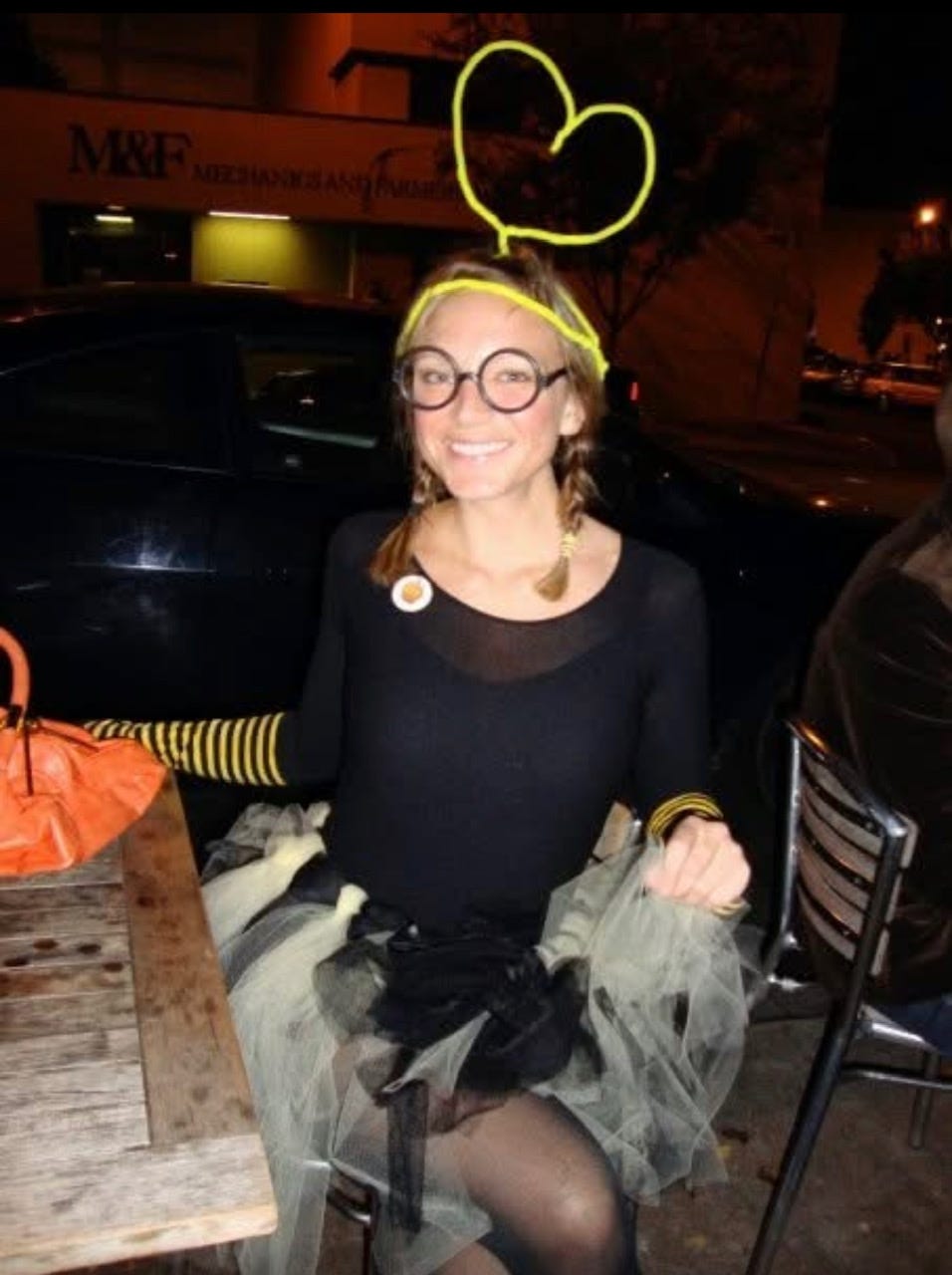
Thanks for reading! Not sure this is a final draft, as this deadline and life collided, but I enjoyed writing it and revisiting the song. Also not sure if it will make the memoir cut, without zooming out to other songs, but this story does seem important for my mosaic. (The memoir-writing process is slow and seems to be never-ending when you care deeply about the impact on self and others.)
Last night, I had a wild synchronicity when riding my bike and passing a parent’s house, singing those lyrics. Some important lines aligned with the exact moment I passed the porch they were sitting on, and I was singing loudly. They laughed, but I’m not sure they heard. Will perhaps write more about that another day.
As a note, after the submission period for the contest, I will paywall this essay, as I do for memoir. I paid (and still pay) for these experiences in other ways, and a paid subscription supports my bigger writing journey. Other content always free. I appreciate you all and your understanding. Thank you for reading and engaging.
Peace, love, and stimulus control,
Jennifer
©Jennifer Haddock, 2026
What evocative writing, Jennifer. Recording songs from the radio, those were the days! And when I did buy an album (or cassette), I listened to it until I knew every song. This TUNE! Stirs up some memories for me, too. Wonderful writing.
What a wonderful work! I love your story *and* your taste in music!